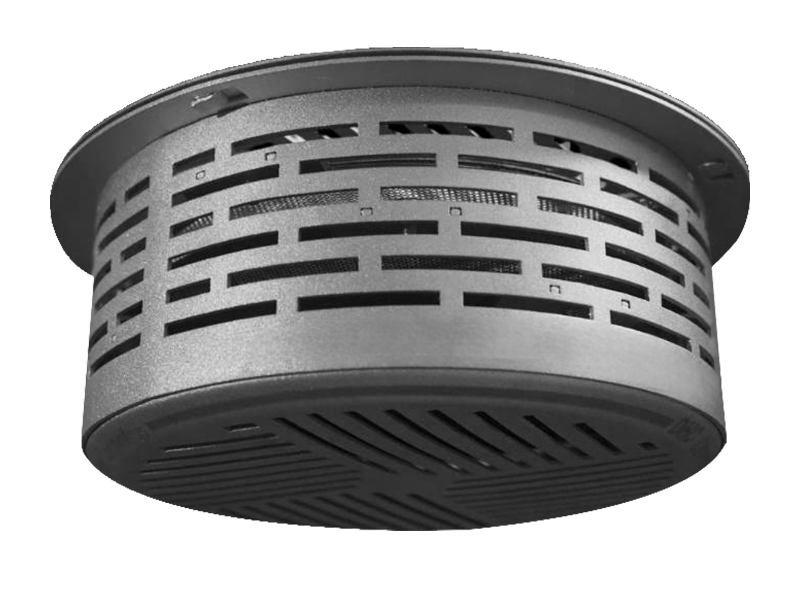
Toplus’ DHC Convection-Type Hydrogen Leak Eliminator adopts precious metal catalyst technology. Without requiring electricity, it safely converts leaked hydrogen into water vapor under room-temperature conditions, immediately reducing the risk of hydrogen accumulation.
DHC is especially suitable for safety protection in areas with limited ventilation or under abnormal conditions such as power failure or equipment malfunction. It helps comprehensively enhance the safety of hydrogen operating environments and equipment.
In addition, DHC features high stability and long-term operation. Without requiring any peripheral control system, it can operate independently and continuously, reducing risks caused by human error or system failure.
DHC can be flexibly deployed according to different site requirements. It is suitable for locations with potential hydrogen leakage risks, including hydrogen laboratories, fuel cell rooms, hydrogen cylinder rooms, lead-acid battery charging rooms, hydrogen-powered vehicles and parking areas, water electrolysis hydrogen production facilities, semiconductor fabs, metal heat treatment plants, electrolytic copper foil plants, hydrogen refueling stations, hydrogen power plants, and hydrogenation process facilities in the food, beverage, and pharmaceutical industries.

Performance Test:
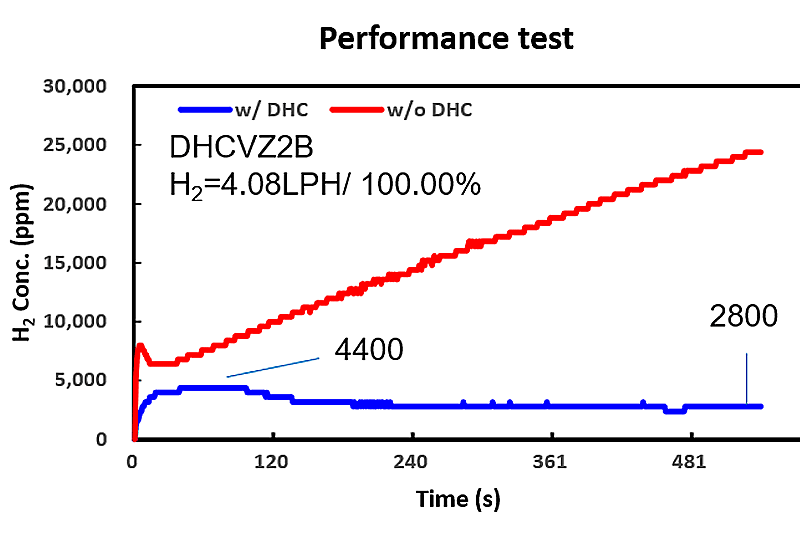
DHC’s hydrogen elimination performance has been verified through UL-witnessed testing.
• In the test, hydrogen was continuously introduced at a fixed flow rate into an enclosed space. The red curve represents the hydrogen concentration without DHC, while the blue curve represents the hydrogen concentration with DHC installed.
• Test results show that when DHC is installed in the enclosed space, hydrogen concentration can be reduced and maintained within a safe range.
DHC uses precious metal catalyst technology to convert hydrogen and oxygen into water vapor at room temperature.
The heat generated during the reaction enhances catalyst efficiency and creates natural thermal convection. This allows hydrogen-containing air to continuously flow into the device and be decomposed inside the unit.
The entire system requires no electricity, enabling continuous hydrogen elimination.
Unique Value:
In the event of hydrogen leakage, existing safety measures may fail. For example, ventilation systems or hydrogen detectors may malfunction, or a power outage may occur.
Because DHC does not rely on electricity or control systems, it can continue eliminate hydrogen independently. This makes it a critical safety reinforcement mechanism.
This value is especially important in Taiwan, where earthquakes occur frequently. DHC can effectively reduce the risks of hydrogen accumulation and explosion caused by the interruption of conventional safety equipment.
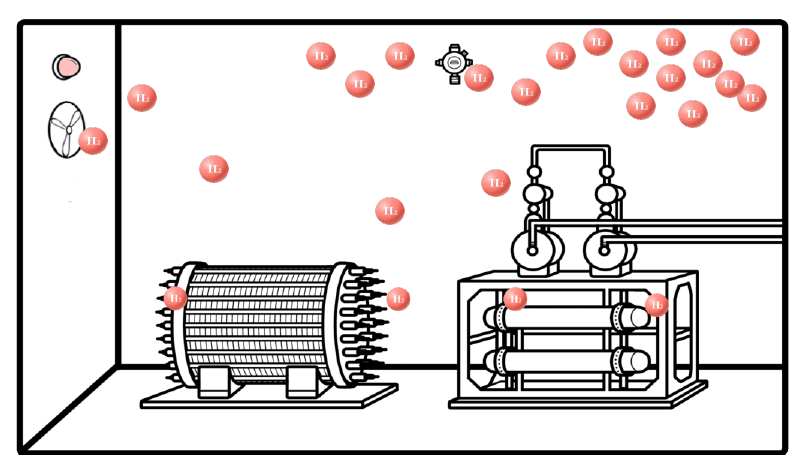
Without DHC (Hydrogen may accumulate)
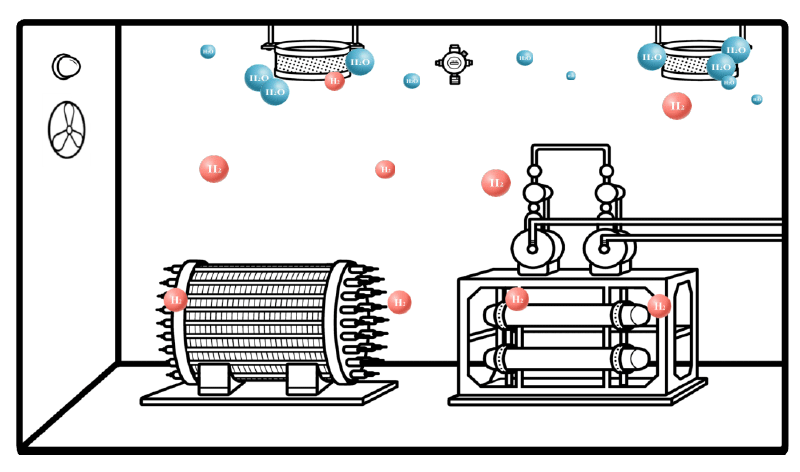
With DHC (Hydrogen accumulation is eliminated)